Publication and Validation

Before I began my current job, especially when I was an undergraduate student, I was relentless in attending a wide variety of poetry related events–book or magazine launches, readings, and open mic nights–in order to network and learn the ins and outs of the literary world. At one point, I even ran a monthly reading series at the University of Toronto’s historic Hart House. The embarrassingly atrocious attendance for these readings did nothing to dampen my youthful enthusiasm.

Now, as a full-time ESL teacher and part-time martial artist, it is difficult to find time. On the rare occasions that I can make it to a launch or reading, I am typically in the company of at least one or two acquaintances that I made from my more ambitious days. Inevitably, the question always arises: “So have you been doing a lot of writing these days?” My response is almost automatic: “Writing a lot, but publishing very little.”

I began to wonder why I feel the need to distinguish between the two, or to qualify my answer at all. Why is it that “successful” writing is supposed to lead to mainstream publication?

1) External Value
We do love our validation . . . right?

The notion that publication from an established, third party confirms the value of the work is ingrained in many writers. It doesn’t matter that, in many cases, the writer may have personal associations with the editor who is selecting the work; the letter of acceptance is seen as impartial validation that the words on the page are of value.

Of course, having your submission selected from the slush pile by an established publisher lends credence to the quality of the writing. However, as print media continues on its path to extinction, the competition in the market also suggests that many worthwhile pieces (perhaps from more obscure or less connected authors) will be increasingly receiving rejection letters in response.

At the risk of admitting my own incompetence, I will admit that sometimes when I receive the magical words of acceptance from an editor, I am surprised–not necessarily by the fact that they chose one of my pieces, but more that they overlooked the ones that I felt were the strongest in favour of those that I felt were inferior. Perhaps thematically or stylistically they fit better with the issue of the magazine being compiled, or perhaps I simply don’t know my successes from my failures until an editor informs me of the result.

2) Audience

They love me! They really really love me!

Very few writers produce work exclusively for their own satisfaction, however much they may claim not to care what others think. Writers need readers to be satisfied with their product. Publication is the easiest way to access an audience wider than one’s own circle of friends and family members, who may also be too polite to tell you that they hate poetry.

An unfortunate reality of the current market is that we have an excess of writers and a shortage of readers, especially when it comes to creative writing. Fiction is more likely to be read by many who don’t write fiction; poetry, especially, is not. It is also astounding to see how many authors will attend events but refuse to purchase books in support of the press they are hoping to eventually publish with. Naturally, from a financial standpoint it is impossible buy every book we encounter–we are poets, after all–but if we hope to utilize the industry to advance our own careers, we have to invest in it too, before it disappears entirely.

3) Intention

Although not in all cases, at times we may sit down to write with a specific publisher in mind. Themed issues of magazines especially provoke this kind of response. The illusion of the pure, unadulterated moment of inspiration is still powerful and widespread, but the reality is that most authors intend for their work to be published–either by a specific press or an anonymous one–when they are creating and editing it. This intention means that we are thinking about how work will be received by an audience before it even has one.

If the work is originally meant for a reader and doesn’t find one, this will naturally be disappointing. We all feel that deflating sensation when we realize that a response to a submission is a rejection rather than the acceptance we were secretly hoping far too much for.


It is difficult to know whether it is possible to feel successful without attempting to publish. If the goal is to write better, more meaningful pieces, who measures: the author, the publishing industry, or the readers?

It is both reassuring and frightening to know that, like me, publishers may not know exactly the value of their own decisions either. They may accept books or pieces that they think are works of literary genius, but get a mediocre response, and be on the fence about other works that turn out to earn universal praise and numerous awards.

It is also true that many authors are not fully appreciated in their own lifetimes, but their work resonates generations later. In the moment, it is difficult to know whose words will address the malaise of a future society that hasn’t manifested yet.

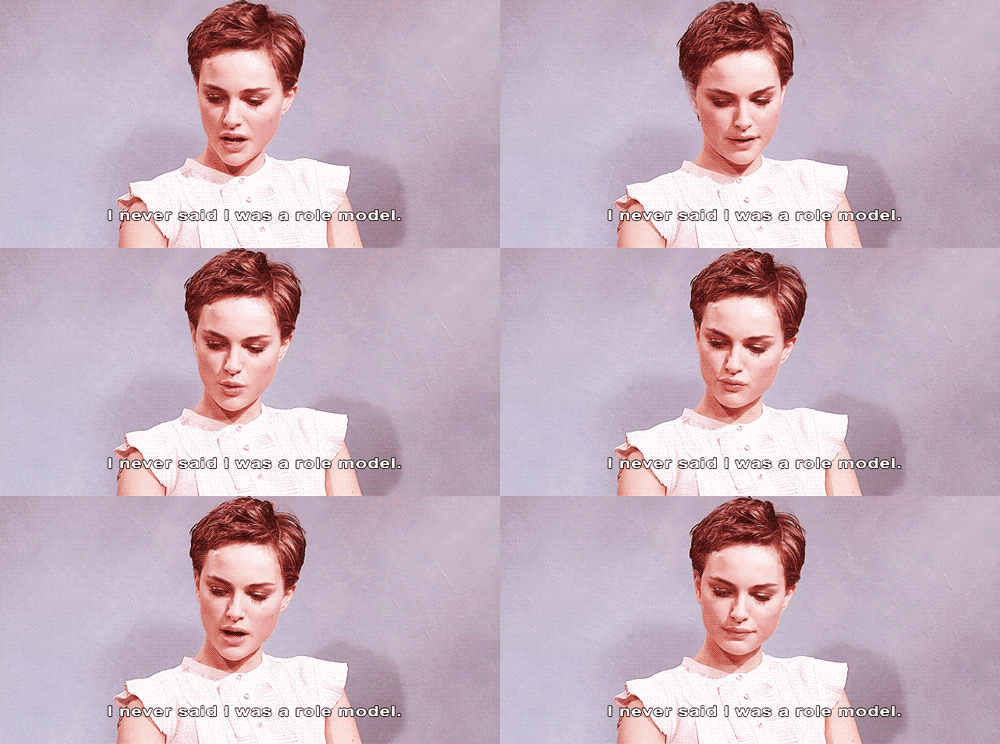
How Not To Be a Role Model

Here I am setting an example. Possibly a bad one, but still.

Any experienced teacher knows that the majority of students are ultimately headed for the door, but it is equally obvious that the teacher is probably the largest variable in determining who stays and who leaves, and how long that process takes. Testimonials point out that those who develop an aversion to martial arts often have a bad experience with a particular instructor, and often don’t get past that barrier to actually learn anything about the art itself. 

Conversely, the reason many students stay is largely due to the influence of their instructor. Especially for those who practice martial arts in their formative years, the teacher can be a huge role model in terms of developing one’s character, identity, work ethic, and sense of morality.

However, the role of the Sensei is a fluid one and the relationship between the instructor and student depends on a number of factors. 

The Western Notion of “Sensei”:

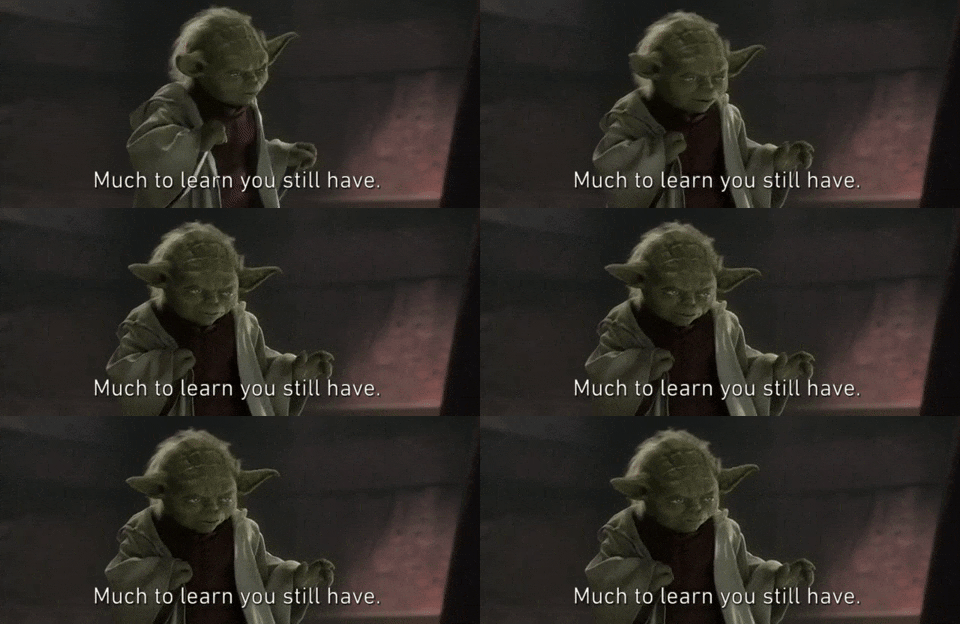
            Dave Lowry summarized the image of a martial arts instructor in Western culture best as “a combination Yoda—Mr. Miyagi who is infinitely wise and can solve all my problems.”[1]The prominent aspect of both these characters is not expertise in their respective arts, but insight into all facets of life. There is nothing wrong with a teacher having influence on a student’s life outside the Dojo, but of course giving a student advice about which career path to choose or whether to buy a house or condo is typically outside the instructor’s area of expertise.

            In Japanese Budo, the term to refer to the instructor is Sensei, comprised of two characters. 先(Sen) literally means “before”, and 生(Sei) means “birth” or “born”. We can see quite clearly that this connotes that someone is older and more experienced, shedding light on the path of those following behind him or her.

            The same term is used in Japanese culture to refer to doctors, lawyers, professors, and teachers of other subjects. While it is certainly a term that carries respect, it also contains the notion that someone is an expert in their given field, rather than a “master,” as many seem to assume.

            Japanese culture is hierarchical in nature, as is reflected in both their customs and language. How deeply you bow is dependent on your position relative to the other person. Exchanging business cards is an essential, ritualized practice to determine who is of higher and lower status. The way verbs are conjugated also demonstrates the relative status of each person, based on age, profession, and relationship with one another. This hierarchical culture seems to have been imitated upon the introduction of Budo to foreign countries, where terms such as Sensei have taken on the weight of authority in the context of cultures that are not based on the same rigid social structures.

            It is interesting to note that in Western culture, many are willing to submit themselves to the absolute authority of a Sensei, yet less willing to do so for their supervisor, parents, or landlord. Somehow, the exotic image of the Sensei contains the notion that he or she is the ultimate authority on everything and a person without a single vice, not just an expert in a particular art.

Why Students Want Yoda to Teach Them:

            In some cases, teachers are the ones who put themselves on a pedestal and expect the unqualified worship and awe of their students. Although this is incredibly selfish, it is easy to understand: the ego is fuelling this way of thinking to protect their insecurities.

            Slightly more difficult to analyze is why students believe that their instructor must have unlimited wisdom and power. This can also be a result of insecurity of some kind, possibly lacking authoritative roles earlier in life. For others, it may be more of a military mindset, where the learner in question wants rigid ranking structures to know exactly where he or she stands. A central authority figure makes passing on knowledge unidirectional and therefore without ambiguity, so they want to believe that the Sensei is always right.

            More importantly though, many students who have preconceptions about martial arts don’t want their faith shaken. They are afraid of becoming disillusioned, because it is often the mysticism of Budo that draws people to martial arts in the first place. They want to believe some magic is involved. If they see their Sensei bleed—literally or figuratively—then it shatters not only the image that he or she is invincible, but also the hope that the learner might be able to acquire the same ability.

            The easiest way for an instructor to avoid promoting this image is to train with the students. Ideally they will see the skill, knowledge, and expertise of the Sensei, but also learn that, yes, he or she does sometimes still get hit and no, the universe doesn’t explode when it happens. The reality of self-defense is that no one is unbeatable, and teaching anything different is misleading the learners away from that reality.

Don’t Give a Sage Advice:

            None of this is to imply that a Sensei can’t be a role model for a student, in the same way that a sports coach or a high school math teacher may become a role model if they connect well with a particular learner. However, the extent to which that influence extends needs to be moderated by a number of factors. 

            One of the reasons many parents register their children in martial arts is for them to develop positive character traits and be exposed to a disciplined and austere environment. Children who grow up with martial arts as a hobby often idolize their Sensei or Senpai, and imitate them in ways beyond simply punching and blocking. Learning the value of respect and effort can be a lasting influence and a lens through which a person begins to see all aspects of his or her life. This is the “Do” of Budo at its absolute best.

            However, we see things differently as children, teenagers, and adults. I grew up in the Dojo, and I remember believing that my teachers never drank, swore, or smoked, but of course no one is an angel. We all have vices and flaws, and as I got older and spent more time with the teachers outside the Dojo, I realized this. I believe this is an important process in a healthy relationship with a maturing student: letting him or her see who you really are as a person outside of the martial arts—both the good and the bad.

            Of course, there are also many students who join as adults, and depending on your relationship, it may not be appropriate whatsoever to act as a role model for them. As an illustration of this, my older sister recently joined my Dojo. I wouldn’t suddenly begin giving her life advice or expecting her to idolize me because she became my student. I also have a student who has a PhD, works for Google, and is close to two decades my elder. It would be wildly inappropriate for me to give him advice about anything other than Budo. 

            The idea of an instructor becoming a role model is an organic process and shouldn’t be force-fed to the learners, no matter their age. For a Sensei, the best thing to do is exemplify the behaviour you want to promote. Those who are looking for a role model will latch onto you, and those who are not interested will absorb what they want from your teachings.

Judge Actions, Not People:

            I had an interesting conversation recently with a fellow instructor about a student of his who is incredibly intelligent, highly educated, and extremely successful. The instructor had a dilemma because this student was behaving in a way that the instructor didn’t approve of, but the instructor also felt uncomfortable reprimanding someone older and more accomplished than himself.

             Although every relationship between an instructor and student is dynamic and depends on myriad variables, a student’s behaviour in the Dojo is the Sensei’s jurisdiction. It can be hard to address because of who that student is, but if a certain action is inappropriate, the Sensei’s responsibility is to ensure it doesn’t happen again.

            A litmus test I often use to determine whether an action is appropriate or not is imagining how I would react if a brand new student did the same thing. We often excuse certain behaviours or criticize others because of who is doing it, but if I imagine a white belt doing or saying the same thing, I get a true judgment on whether I am critiquing the action itself or the person.

The Conclusion: Treat People as Whole People

            As much as Budo contains its own norms and taboos, derived largely from its culture of origin, perhaps the best approach to take as an instructor is to not treat your art or yourself as something special. Learners join the Dojo for vastly different reasons; they stay for vastly different reasons; they leave for vastly different reasons. Some people need their Sensei to be a mentor, some need them to be a coach, some need them to be a personal trainer, some need them to be a friend, and others may just need someone who’s really good at self-defense. The point is that if you impose your own view of what you should mean to your students, you risk failing to hear what they want to get out of the relationship. There are already enough people who tried martial arts and were ultimately disappointed by their instructor—it’s time we let the students define what a Sensei means.


[1]Lowry, Dave. The Essence of Budo.Shambhala Publications, 2010. Pg. 129.